_converted%5B1%5D.avif)
Mortgage application
Collect sensitive client documents. Securely, completely, and without email.
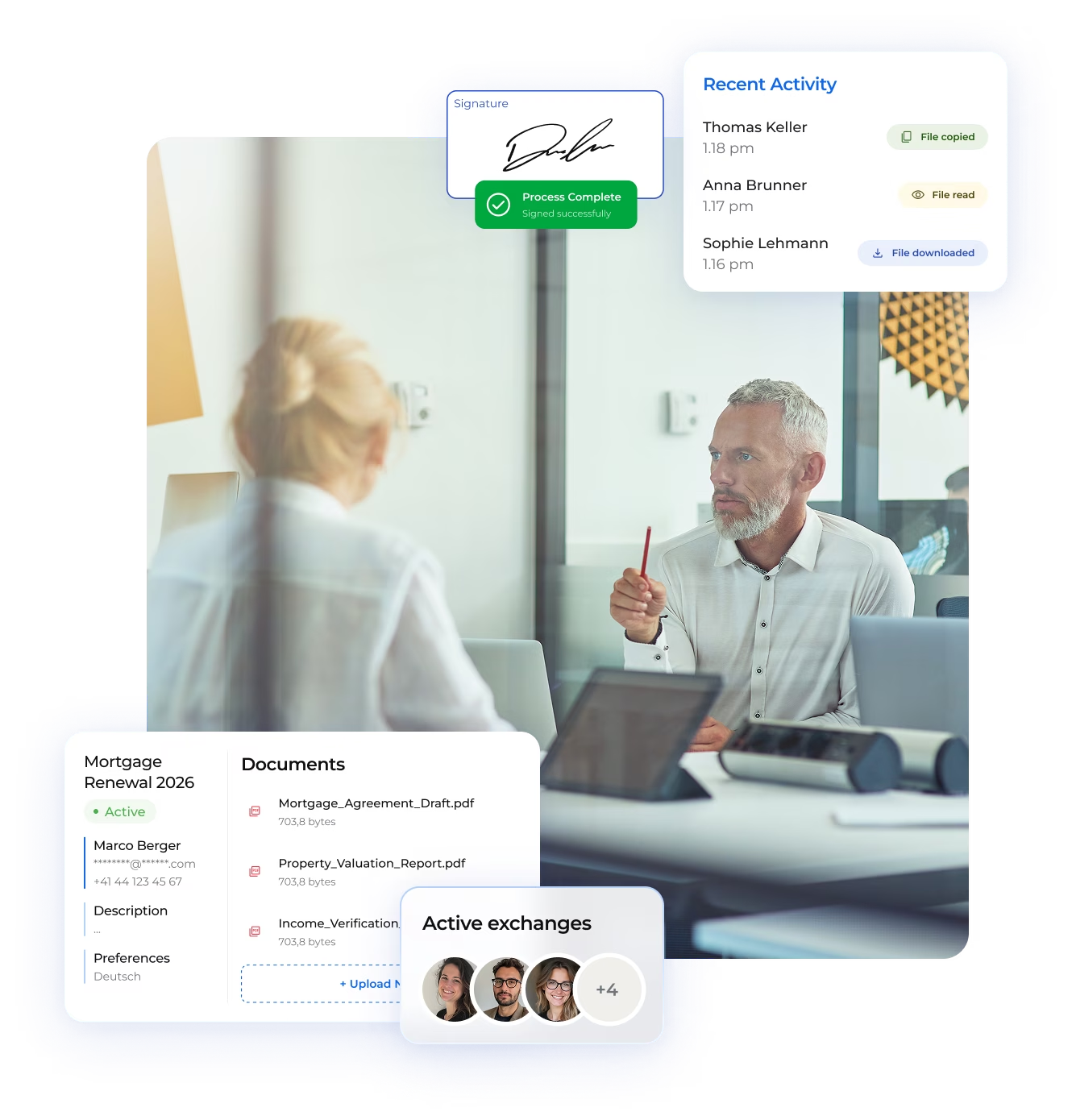
Mortgage applications require the exchange of highly sensitive financial documents between advisors and clients. SecureSafe Exchange replaces fragmented email chains and insecure file transfers with a single encrypted channel, giving your team full control over what's been requested, what's been received, and secure role-based access throughout the lifecycle of an exchange.
%20(1)_converted.avif)
Challenge
Mortgage document collection was never designed for email
In most institutions, gathering the documents needed for a mortgage application (pay slips, tax returns, proof of equity, land register extracts) still relies on email, physical mail, or ad-hoc file-sharing tools. These methods create friction at every step: for the advisor managing incomplete submissions, for the client navigating unclear instructions, and for compliance teams left without a verifiable trail.

Sensitive documents traveling through unprotected channels
Clients routinely send income statements, tax filings, and identity documents as email attachments, unencrypted and often to shared inboxes. Once sent, neither party has control over where those files end up, who forwards them, or how long they persist on intermediate servers. The exposure window is wide, and the risk compounds with every application.

Incomplete submissions and manual follow-up cycles
Missing a single document, whether a property valuation or a pension statement, stalls the entire application. Advisors spend hours tracking down what's outstanding, sending reminder emails, and cross-referencing across threads. There is no automated mechanism to verify completeness before the file reaches underwriting, so errors surface late and cost time.

No audit trail and no access governance
Once documents are exchanged via conventional channels, there is no centralized record of who uploaded what, when it was accessed, or whether it was shared further. In a regulated process like mortgage origination, this lack of traceability creates compliance exposure and makes it impossible to reconstruct the chain of custody if questions arise after closing.
How a mortgage application flows through SecureSafe Exchange
From the first document request to final submission, SecureSafe Exchange gives advisors and clients a single, structured channel for the entire mortgage application process. Every step is tracked, every document is encrypted, and nothing gets lost between email threads or shared drives.
Step 1: The client advisor creates an Exchange and defines the folder structure
The client advisor logs into the Exchange platform, clicks "Create," and sets up a new Exchange for the mortgage application. They give it a name, add a business case description, and define a folder structure that reflects the required document categories: proof of income, tax returns, property valuation, land register extract, proof of equity, and any additional materials specific to the financing structure. The advisor then enters the client's contact details (email and mobile number for 2FA) and can either send the secure link immediately or choose to send it at a later stage directly from the application.
Step 2: The client receives a secure link and uploads documents
The client receives the link via email and is directed to the Exchange login page. By clicking "Send 2-factor code," the client receives a verification code via SMS. After entering the code, the client lands on the Exchange overview page, where they can see the folder structure the advisor has prepared. The client uploads documents via click or drag-and-drop into the corresponding folders and, once ready, clicks "Share documents" to make them available to the client advisor. The advisor is notified by email that documents have been shared.
Step 3: The client advisor reviews, requests corrections, and closes the Exchange
Review and document management:
The client advisor opens the relevant Exchange by clicking on it from the overview and reviews the uploaded documents directly within the platform. They can download files, rename or restructure folders, and upload additional documents from their side if needed.
Requesting corrections or additional documents:
If a document is incomplete, illegible, or outdated, the advisor can adjust the folder structure, add new folders for missing items, and re-send the secure link to the client. The client accesses the same Exchange using their original link and uploads corrected or additional files without starting a new exchange.
Closing the Exchange:
Once all documents are received and the mortgage application moves to processing, the client advisor closes or deletes the Exchange. This removes client access and ensures that sensitive financial records are no longer available after the process concludes.
Capabilities
What makes SecureSafe Exchange different
SecureSafe Exchange was built for regulated industries where document exchange isn't just an operational task but a compliance obligation. Every capability is designed around a single principle: sensitive data should be protected by default, auditable by design, and accessible only to the right people for the right duration.
Encryption
Full encryption in transit and at rest
Every document uploaded to an Exchange is encrypted individually using AES 256-bit and RSA encryption, both during transmission and while stored. This means that even in the event of a server compromise, no single breach exposes all files across all exchanges. For mortgage workflows where clients submit identity documents alongside financial records, per-file encryption ensures each asset is independently protected.
Activity logs
Activity log for full visibility
Every upload, download, view, and access event within an Exchange is recorded with a timestamp and user identity. Client advisors can see exactly when a document was submitted or accessed, giving them clear oversight of the exchange at any point. This replaces the guesswork of email-based workflows with a transparent record of all actions taken within the platform.
Client access
No-account-required recipient access

Clients access the Exchange via a unique link and two-factor authentication via SMS. No registration, no app download, no password to remember. This removes the single largest adoption barrier in client-facing document collection: the requirement to create yet another account. For mortgage applicants already managing dozens of administrative tasks, frictionless access directly translates to faster, more complete submissions.
Roles
Deputy assignment and advisor reassignment

If a client advisor leaves the organization, changes roles, or is temporarily unavailable, the Exchange can be reassigned to another advisor without losing document history, folder structure, or client context. This ensures continuity in the mortgage process regardless of internal staff changes, and avoids disrupting the client relationship or forcing a new exchange to be created from scratch.